Welcome!

Welcome to the Bookshelf Detective, a site packed with tricks and tips for readers and writers of children's literature. Thank you for visiting!
Cheers,
Kim Tomsic

Wednesday, May 18, 2011

How to Frame Past Perfect Tense: a guest post by Will Limón

A brief word from Kim: I describe past perfect tense as the past of the past. Grammar Girl, Mignon Fogarty, says to write past perfect you use had + past participle. That's excellent information for a line or two, but a bunch of "had's" on a page gets cumbersome. I had to check in with my friends, Will Limón and David Deen, to learn how to introduce past perfect tense in the framework of a story.

Q: Will Limón, friend, critiquing partner, and go-to guy for the rules (other than David )...how the heck do you frame a situation in past perfect tense?

Will:  Here's my understanding of how past perfect works.


You're cooking along in a piece, using past tense consistently.


A character remembers an action that happened in that character's past, and you (the author) want to recount it within the story.

As you begin the character's memories, you use "had" two or three times to begin the past perfect frame. Then, you simply continue in regular past tense, dropping "had."

As you approach the end of the recounting, you pick up "had" again and use it two or three times in the last few sentences. That completes your past perfect frame.


 You continue on with your story, using past tense as before.

Here's a rather overwrought example off the top of my head. Let me know if it's clear for you.

A short excerpt by Will Limón for your past perfect entertainment privilege:


She sat down at her desk and opened the drawer. The ivory invitation stared her right in the face, its fancy letters mocking her like the echo of his voice.

“After all this time you're finally invited,” he had said. “I bet you won't go.” He had slumped onto the sofa, smirking, and daring her to fight.

She hadn’t looked at him. Instead she gazed out the window at the roses. They were just about to bloom. She stared hard as if the bursting buds were the only thing that mattered in the world.

“Well?” he said.

“Well, what?”

“Are you going?”

She turned away from the window and back to the room, avoiding his eyes. But she felt them. They pricked at her more sharply than the thorns on those rose stems. Something had to give. 
“I don’t know.”
He had laughed. Before he had the chance to say anything else, she’d had him thrown out.

She picked up the invitation and dropped it into the wastebasket. There, that's better. Much better.
David Deen, the Research King, recommends the following websites (just click on the link):

Writing Genre Fiction: A guide to Craft


Past Perfection at Writer's Relief Blog

Fantasy Fiction Cliche's to Avoid


Saturday, May 7, 2011

Book Review: As If 12 3/4 Isn't Bad Enough, My Mother Is Running for President

The word, H-I-L-A-R-I-O-U-S.
As If 12 3/4 Isn't Bad Enough, My Mother Is Running for President (Delacorte Press/Random House Children's Books 2008) by Donna Gephart is about seventh-grade Vanessa Rothrock who has a few wishes in life:
5. win the spelling bee;
4. discover her secret admirerer's identity;
3. receive a gift (the gift!) from the boob fairy;
2. snag another wink and phone call from Reginald;
1. keep Mom safe and out of the election.

It's easy to see why As If 12 3/4 Isn't Bad Enough, My Mother Is Running for President won the 2009 Sid Fleishman Award presented at the SCBWI's national convention. The Sid Fleishman is the prestigious award granted to honor an author "whose work exemplifies the excellence of writing in the genre of humor." Translation: the book is snort-out-loud funny.

As If 12 3/4 Isn't Bad Enough, My Mother Is Running for President
5 out of 5 lollipops
  • ISBN-10: 0440422116


  • ISBN-13: 978-0440422112


  • Hard cover list price $11.99/ Kindle $7.99


  • Rating 5 out of 5 lollipops!


  • Book Jacket: "As if being 12 3/4 isn’t bad enough, Vanessa Rothrock’s mother is running for president and it’s ruining her life. Isn’t it enough that her enormous feet trip her up all the time, even on stage during the school spelling bee? Isn’t it enough that Reginald Trumball, love of Vanessa’s pathetic life, read her personal and private list of deficiencies to some boy she doesn’t even know? And that the Boob Fairy hasn’t visited her even once?! Doesn’t Mom realize that Vanessa needs her more than the rest of the country? More importantly, doesn’t she realize that she may be in grave danger? Vanessa's receiving threatening notes at school–notes that imply some psycho has it out for her mother at the Democratic National Convention. Vanessa might be the only person who can save her. But does she have the courage to do what that requires?"

    Thursday, May 5, 2011

    A Quick Quirky Question for Holly Schindler author of PLAYING HURT

    KIM: Welcome Holly Schindler. Thank you for visiting my blog to answer one quick quirky question . If you were to have a FREAKY FRIDAY switcharoo moment that lasted just for a day, would it be with your mother, your Pekingese, or with one of your characters (and if so, which character)?

    HOLLY:  My knee-jerk reaction is to say my Peke, Jake. That dog should truly be crowned World’s Most Spoiled. He gets the steak while we eat the hamburger. And he’s truly the most loved little thing on the planet. I’m sure everybody thinks that of their animals, though...

    If I could switch places with one of my characters, I’d switch with Brandon , Chelsea ’s brother in PLAYING HURT. 

    In the first place, I really love the way that Brandon just is who he is…He’s probably the most open of any of my characters. There’s such a joy about him, as he dances onstage in Pike’s to his music. 

    … Brandon also never sits on anything, lets anything fester inside. He speaks his mind. He lets Chelsea know exactly what he thinks—when he suspects she’s hurt during her last game, or when he suspects she’s having a love affair with Clint.  
               
    He’s also really trustworthy—the kind of person Chelsea knows she can rely on. He’s the person she reaches out to, after Gabe’s learned the truth about Clint and has stormed out of their hotel room. And even though Brandon doesn’t like how Chelsea ’s handled Gabe, he does rush to The Carlyle to help her out...

    In a lot of respects, Brandon ’s the kind of person everyone strives to be: honest, dependable, totally unashamed to put himself out there.

    So, yeah— Brandon . If I could be anybody, I think I’d be him.


    Star basketball player Chelsea “Nitro” Keyes had the promise of a full ride to college—and everyone’s admiration in her hometown. But everything changed senior year, when she took a horrible fall during a game. Now a metal plate holds her together and she feels like a stranger in her own family.
    As a graduation present, Chelsea ’s dad springs for a three-week summer “boot camp” program at a northern Minnesota lake resort. There, she’s immediately drawn to her trainer, Clint, a nineteen-year-old ex-hockey player who’s haunted by his own traumatic past. As they grow close, Chelsea is torn between her feelings for Clint and her loyalty to her devoted boyfriend back home. Will an unexpected romance just end up causing Chelsea and Clint more pain—or finally heal their heartbreak?
    A BLUE SO DARK Jacket Copy:
    Fifteen-year-old Aura Ambrose has been hiding a secret. Her mother, a talented artist and art teacher, is slowly being consumed by schizophrenia, and Aura has been her sole caretaker ever since Aura’s dad left them. Convinced that “creative” equals crazy, Aura shuns her own artistic talent. But as her mother sinks deeper into the darkness of mental illness, the hunger for a creative outlet draws Aura toward the depths of her imagination. Just as desperation threatens to swallow her whole, Aura discovers that art, love, and family are profoundly linked—and together may offer an escape from her fears.

    Saturday, April 30, 2011

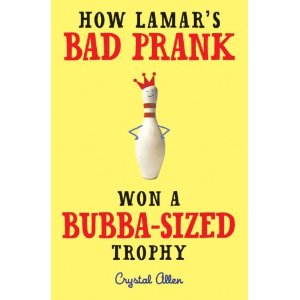
    How Lamar's Bad Prank won the NEWBERY a book review by Kim Tomsic


    Middle schooler, Lamar, is an Indiana boy trying to convince the Hoosier-cult community that bowling is better than basketball. But he's also trying to achieve a lot more...


    Synopsis"Thirteen-year-old Lamar Washington is the maddest, baddest, most spectacular bowler at Striker's Bowling Paradise. But while Lamar's a whiz at rolling strikes, he always strikes out with girls. And his brother, Xavier the Basketball Savior, is no help. Xavier earns trophy after trophy on the basketball court and soaks up Dad's attention, leaving no room for Lamar's problems.

    Until bad boy Billy Jenks convinces Lamar that hustling at the alley will help him win his dream girl, plus earn him enough money to buy an expensive pro ball and impress celebrity bowler Bubba Sanders. But when Billy's scheme goes awry, Lamar ends up ruining his brother's shot at college and every relationship in his life. Can Lamar figure out how to mend his broken ties, no matter what the cost?


    From debut author Crystal Allen comes an unforgettable story of one boy's struggle to win his family's respect and get the girl of his dreams while playing the sport he loves."

    Author Crystal Allen definitely handled her business and  HOW LAMAR'S BAD PRANK WON A BUBBA-SIZED TROPHY seems like a no-brainer for the Newbery (ALA's top award for children's literature). This middle grade novel is laugh-out-loud funny, full of heart and drama,  and packed with voice, v o I C E, VOICE. I can picture writing coaches using Crystal Allen's style as an example of snappy writing, because she is outrageously clever and the master of  many creative elements, like a  Spunk and Bite How-To. The zippy language of Allen's debut book will entertain you on the level of Savvy (a previous Newbery winner) while tugging the same emotional cords as When You Reach Me (oh, what?...another Newbery winner).

    PREDICTIONS: Not only do I predict a Newbery nod (as well as a Sid Fleishman Award), but I also predict a blockbuster movie. Lamar has the flavor of Chris Rock's Everybody hates Chris and will win the same audience as Wimpy Kid.  Anyone who reads Lamar's tale and actually claims they don't love it must be drinking  "Haterade." Why? Because How Lamar's Bad Prank Won a Bubba-Sized Trophy is "shut-yo' mouth" good.

    5 out of 5 lollipop rating
    It's "shut-yo' mouth" good!
    How Lamar's Bad Prank Won a Bubba Sized Trophy (Balzer and Bray February, 2011) by Crystal Allen $16.99 ISBN-13: 9780061992728 and ISBN: 0061992720
    Purchasing Links:
    Barnes and Noble
    Tattered Cover
    Indie Bound
    Boulder Book Store
    Amazon

    MY INVISIBLE BOYFRIEND a YA Book Review

    The Hook: 
    "Heidi has the perfect solution to her popularity problems - a fake boyfriend. She's even made him an Internet profile that makes him look like a motorcycle-riding, poetry reading bad boy. *swoon* Heidi's friends are so impressed they start emailing Heidi's fake boyfriend with their problems . . . including their problems with Heidi."


    MY INVISIBLE BOYFRIEND by Susie Day is a YA reader's must-have. It's packed with a fun hook and creative writing. Susie Day has an M.T. Anderson-ish style (not Octavia Nothing-ish, more Feed) and brings additional writer's spice to the table. Day blends imaginative elements  such as bizarre recipes, imaginary friends, enigmatic characters, and an element of mystery to create a perfect recipe of plot and drama. YA readers will love this book. 

    3.75 out of 5 lollipop rating
    My Invisible Boyfriend (Scholastic Press April 1, 2010) by Susie Day earns a 3.75 out of 5 lollipop rating.
    ISBN-10: 9780545073547


    ISBN-13: 978-0545073547

    Available at list price of $16.99 from many Indie providers (i.e. Tattered Cover, Boulder Books) or from Amazon.

    Tuesday, April 12, 2011

    BOOK REVIEW: Playing Hurt

    Playing Hurt by Holly Schindler will be this summer's YA go-to romance novel.

    When broken basketball star, Chelsea, is forced into a Minnesota Lakes boot camp, she discovers her trainer, Clint, has some wounds of his own. The story is packed with enough heat and tension to ignite the hormones, but can greater healing come about? Author Holly Schindler answers this question in her spicy YA novel,  Playing Hurt (Flux, March 2011).  Playing Hurt is not for the feint of heart reader, meaning it's not for the tween/teen just leaving their middle grade reader in search of a juicier read. It's an older YA novel that promises sexual tension.

    Schindler has a smooth writing style and can turn a phrase in a clever way. Although I would have preferred that the author use only half the metaphors and similes, I couldn't help but love when I read certain hyperboles like, [we were] "so close our eye lashes almost tangled." Schindler did a fantastic job revving up tension. The summer romance between Chelsea and Clint is so steamy that Playing Hurt could easily become this decade's version of Dirty Dancing.


    ISBN-10: 9780738722870


    ISBN-13: 978-0738722870

    Playing Hurt, Flux (March 2011) Available for $9.99 through independent book sellers, Barnes & Noble, Amazon

    Sunday, March 13, 2011

    Fiction Writing Workshop with Sara Megibow of Nelson Literary Agency

    About the Publishing Industry from industry expert Sara Megibow:

    Last year Sara Megibow received 36,000 query letters. Of the 36,000 queries, she requested 2,500 partial manuscripts. Out of the 2,500 she then requested 98 full manuscripts. Of the 98 hopefuls, she offered representation to nine clients and of the nine clients, Sara sold five manuscripts.  Math review--36,000 hopeful queriers and five scored a book deal.


    TRADITIONAL PUBLISHING TIME LINES:

    When you query an agent, you can expect a response with in six to twelve weeks. If they request to read more (partial or full), you can expect your next response in six to nine months. If the agent offers representation, you and the agent may spend time editing your manuscript before submitting to a publishing house. Once submitted, it can take an editor an average of two to three months to read (Sara has experienced wait times from one month to eighteen months). If you are offered a book deal, you can expect to see your book on the shelves in two to three years after the offer. Another math review: if you are starting the query process with your completed manuscript today,  March 13, 2011,you can expect to see your masterpiece sold at your local bookstore in 2014.

    SARA'S ADVICE TO WRITERS:
    Writers need to be aggressive marketers. What's your marketing plan? What Conferences do you attend? Do you know the people at your local bookstore? Do you have a positive web presence? When an agent is considering your work, they will probably Google to investigate your web presence. You should have a positive presence in the following medias:
    Twitter
    Facebook
    Author Web Page

    Sara says establishing an author web page is super-duper important. Okay, "super-duper" is my word, but she highly stressed the need for a web page or a blog site. If you have no web presence, she will probably skip your project. Remember, your competition includes 35,999 other queriers waiting for her attention.


    WHAT A LITERARY AGENT LOOKS FOR (Other than snappy writing):

    1. Do you know your genre (exactly where in the bookstore will your work be placed)?  In your query, you need to be professional and that means you show you know your genre. How? Your protagonist needs to be the right age for your genre; your word count needs to be spot-on and proper for genre; and you need to know precisely where your book would fit on a bookstore shelf.
    "To increase your odds of landing an agent, you need to be able to nail your genre."
    Genre examples:

    Middle Grade- a protagonist who is nine to fourteen years-old (5th 6th 7th 8th grade); word count 30,000 - 50,000. Conflict is something light such as first fight with parents, lemonade stands, changing schools, first crushes, etc. Very rarely "issue-y".

    Young Adult - has a teen protagonist, 50,000 to 90,000 words, can be dystopian, fantasy, romantic, etc. but must be a teen protagonist. Conflict can be anything as deep as issues seen in SCARS (a cutter novel) by Cheryl Rainfield or as fun and light as SCORE (coming out)  where conflict is about a young woman who plays quarterback on her high school football team , but may lose her scholarship because of a boy issue.

    Science Fantasy 80,000-150,000 is preferable word count (but 200,000 okay)

    Urban Fantasy-set on earth, looks like Earth, but some fantastical element 80,000 to 150,000 words.

    Commercial Fiction Chic Lit - usually about first job, fashion, leaving the nest, etc.


    2. DO YOU KNOW HOW TO PITCH YOUR BOOK? Can you tell what your book is about in one or two sentences? Your inciting incident should be in the pitch. For example, when you go to see a movie, you usually know, based on one or two sentences, what the movie is about. These one or two sentences are also known as the elevator pitch (being able to sell your storyline in the time it takes to complete an elevator ride).

    **Inciting incedent is the magic key to your pitch.**

    3. QUERY LETTER - QUERY LETTER 101:
    A query letter is a two paragraph description of your book. Yep, all 50,000 words condensed into two compelling paragraphs. Based on the statistics above, it's easy to understand why writing a great query letter is vital. Sara recommends http://www.agentquery.com/ for more information on this subject.


    She also says Kristin Nelson does a fantastic query letter workshop. Remember that your query should read as if it were the back cover of your novel. Research agent and make sure they rep the type of book you wrote (i.e. don't query your cookbook to an agent who only reps dystopian YA). Query must be no longer than one page. For more help, see http://www.agentquery.com/ or http://www.nelsonagency.com/


    4. BOOK MUST BE COMPLETE - don't query if your work of fiction is not 100% written and ready to go.


    Side note and something to think about: The publisher needs to be able to sell at least 15,000 copies of your book in order to meet their PandL requirements. Figure out what your work is similar to and hope that author had sky high sales. Typical advances for a debute author in children's literature $5-10K.


    Quick notes about Sara:  Yes, Sara is accepting new clients. Please visit her website to learn about the type of projects she represents. Her query information is available at http://www.nelsonagency.com/ Sara's favorite genre- Epic Fantasy. She says a prologues doesn't work if nothing is at stake. Says women's fiction can be more prose, but can often has too much angst. Sara likes STAY as a great piece of women's fiction. She also likes SIMPLY FROM SCRATCH. One of the most important tools in selling your book is nailing your pitch.

    RESOURCES:
    http://www.nelsonagency.com/ and their list of Frequently Asked Questions (FAQ)
    AAR (association of authors' representatives)

    Last minute words of wisdom:  Read books in your genre, avoid data dumps, work on POV, achieve great dialogue, and balance description, show don't tell, and remember, a reputable agent never gets paid for reading your work.
    By the way, Sara donated her time for this workshop to raise money for a Colorado school.


    Organizations you can join: 

    http://www.scbwi.org/ for picture book, middle grade, and YA writers
    http://www.rwa.org/ for romance writers
    http://www.rmfw.org/ for fiction writers

    Saturday, February 26, 2011

    The Hole in the Sky: a book by Barbara Mahler


    Colorado author, Barbara Mahler, enjoyed a school visit with a classroom in Cairo, Egypt. Click on the YouTube link.


    What are the reviewers saying on Amazon?

    Amazon Reviews:

    I read this book from cover to cover in the span of a few hours. I felt like I was cheating myself of Kaela and her new extraordinary and supernatural friends whenever I put it down to eat. This book doesn t contain an extraneous word or a boring scene. The story flows from page to page like a beautiful clear stream. In the end, I still craved for more of Kaela Neuleaf and her cousin Shawn. --Gema Mora, Radical Parenting

    The presentation of the book from its beautiful cover to the map to the book mark ribbons would be a disappointment if the author, Barbara A. Mahler, had not written a story to warrant such an amazing presentation.The book made me wish I had a young daughter and we could read it together. --Julie Marie Totsch, Blogcritics

    I was lucky enough to receive a review copy of The Hole in the Sky by Barbara A. Mahler. I read this story and couldn't put it down! I finished it in a few nights reading it before bed. Much like absolute favorite young adult books, the Twilight Saga books, The Hole in the Sky is for teens, but could certainly be read by a young adult or adult even, and you'd love it just as much! I would absolutely recommend this wonderful book for the upcoming holidays. --Mary512, 512KIDZ 
     
    Would you like to read a sample? Click on "sample" or type www.holeinthesky.net or buy a copy from Boulder Books or online at Amazon.


    Need more reviews?  visit Good Reads

    Wednesday, February 16, 2011

    Book Review: BLACK EAGLE FORCE A Guest Post by Joseph Provost

    GUEST BOOK REVIEW BY JOSEPH PROVOST: I was the lucky winner of an advanced reader copy of BLACK EAGLE FORCE by Buck Stienke and Ken Farmer. Kim Tomsic suggested this book and I'm thankful she did as I found it beyond exciting. I took the book with me on a 10-day volunteer trip to Haiti and I found that every chance I had to relax was spent reading the next chapter.

    From the beginning of this military thriller to the end, the reader feels like they're on an adventure. Stienke and Farmer start with Santa Anna's campaign in 1860 and take you through to present day in a way that makes you feel like you're reliving history.

    When I finished reading Black Eagle Force, I shared the book with my friend, Peter Hughes (retired military). I said, "Trust me. Just read ten pages and see if you like it." Peter couldn't put it down. He didn't want to give the book back as we flew home from Port au Prince, but fortunately he finished before we landed. He agreed Black Eagle Force is a great read and easily deserves a five out of five star rating. Thank you Buck and Ken. You brought back memories of my time based at Fort Hood.

    For more information, visit www.blackeagleforce.com


    Sincerely,

    CWO 2 (retired)

    Joseph Provost

    Quartermaster Core
    (and for more about Haiti, visit http://www.thefriendsofhaitiinc.org/)

    Saturday, February 12, 2011

    Black History Month Book Picks by Kim Tomsic


    In honor of Black History Month, please enjoy a few of my book suggestions.  Same Kind of Different as Me written by Denver Moore and Ron Hall (nonfiction) is a beautiful story of friendship. The writing is not fancy and the plot is not hard-driving, but the sheer fact that this is a true tale is enough to keep your eyes glued to the pages.  If you're in the mood to laugh and cry, this is the book for you.
    Another great choice is  Lincoln and King mentioned in one of my previous blog posts. 

    It only seems appropriate to pick a Coretta Scott King award winning book as my next choice, so I suggest  My Rows and Piles of Coins by Tololwa M. Mollel. Although this is a beautiful story of generosity and determination, I admit my true draw to the book had to do with the illustrator. I'm a huge fan of  E. B. Lewis   and was captivated by the watercolors he used to bring this story to life.
    Kadir Nelson is another illustrator whose beauty with a paintbrush  can influence your  purchase of a book.   Moses:  When Harriet Tubman Led her People to Freedom by Carole Boston Weatherford and illustrated by Kadir Nelson will delight you with both artistic beauty as well as lyrical text.

    Thursday, February 10, 2011

    Fast-Paced Plotting as seen by Nancy Drew and Chris Eboch

    A standing-room-only break-out sessions at the SCBWI Conference was a class taught by Chris Eboch .

    What I learned from Nancy Drew-Tool for Fast-Paced Plotting was the title Chris Eboch gave her presentation.

    Literally, all the fire codes were violated as the Hyatt salon was packed with standing room only participants. Here are a few precious notes on what Chris had to say:
    BEGINNING

    1. You are setting expectations and making the reader a promise in the first chapter…a promise you better fill. If your tone is crazy-scary in the first chapter, you better deliver crazy-scary. If your characters are super snarky in the beginning, they better not end up vanilla throughout the rest of the book.

    2. Your first chapter also sets the genre, setting, problem, tone, and a sense of the structure and pacing.

    HOW TO CREATE A FAST START

    1. Fast starts are openings that start with action; they start with what happened and then work in the back story. Note how this is different from starting with back story and then working up to the action.
    2. Ms. Eboch says that fast starts usually start with two people on the page and has scene+action+dialogue. She advises to use description and summary modestly if you want to achieve a fast start.
    3. Ms. Eboch also advises to start with a cliffhanger (something big is around the corner) and in the middle of the fight or the conflict. She says, “the inciting incident-the problem that gets the story going-should happen as soon as possible , but not until the moment is ripe.”
    For more on Chris Eboch’s guide to writers and fast paced plotting, you can visit her at http://www.chriseboch.com/

    Tuesday, February 1, 2011

    Contest: ARC Giveaway

    CONTEST:  WIN AN ADVANCED COPY!

    Quinn Cummings is hosting her first ever ARC giveaway.  She is offering a signed copy of Sara J. Henry's debut novel LEARNING TO SWIM (click link if you'd like to see my review). 

    Here's what Ms. Cummings has to say about the novel:
    "... Fresh setting, well-realized characters, cleanly written, with a mysterious and suspenseful story - just what I was looking for." - Daniel Woodrell, award-winning author of The Death of Sweet Mister and Winter's Bone

    Did you catch that? WINTER'S BONE! The man who wrote maybe one of the most interesting thrillers I've read in years thinks Sara's book is great. He's right.

    To Win a signed copy of LEARNING TO SWIM, please comment on Quinn Cummings blog  Good luck!

    Would you like to see a contest on my blog too?  Let me know

    Thursday, January 27, 2011

    More about Starch Resistant Carbs and Benefits

    Today, Shine from Yahoo has an attractive article and I was easily lured by the title:
    8 Reasons Why Carbs Help You Lose Weight.
    Shine's eight reasons why you should eat starch resistant carbs include: "carbs make you thin, carbs fill you up, carbs curb your hunger, carbs help control your blood sugar, carbs speed up metabolism, carbs blast belly fat, carbs keep you satisfied, carbs make you feel good..."
    The problem with the article, however is that it talks a lot about Resistant Starch carbs, but fails to do a thorough job identifying what that means. When I browsed the article, my brain tried to skip over the whole “Resistant Starch” part and jump right to the focus: Carbs Help you Lose Weight. But once reality set in, I was certain that Mac & Cheese and Captain Crunch aren’t going to get me bikini-ready.

    DEFINITION


    Resistant Starch: A starch which goes undigested in the body


    Simply put, a resistant starch acts like a dietary fiber. When you eat a resistant starch food, you feel satisfied and full, and just like a fiber, the part of the food that is a resistant starch goes unabsorbed and passes through your body. Some call the food “fat burners.” Another positive spin--a healthy enzyme called Butyrate is created by resistant starches. Many in the medical community believe butyrate not only helps prevent colon cancer, but it also boosts the immune system.


    Skinny, Healthy, Disease Resistant…I love it!

    Why a starch is resistant?


    1. It has a fibrous outer shell (i.e. grains and legumes that are cooked intact);


    2. It’s a starch our digestive enzymes can’t break down (i.e. unripe bananas, uncooked potatoes **I repeat, uncooked, and plantains);


    3. It’s been chemically altered (yhick, no thanks);


    4. It’s created in the cooling process (i.e. when potatoes are cooked, they are 95% starch and the last 5% becomes resistant starch in the cooling process).


    LIST OF RESISTANT STARCH CARBS:


    ******Before****** you add these food items to the top of your grocery list, please note that all beans (and bananas, etc.) are not created equally. These items need to be in their purest form. For example: canned beans are going to have a high glycemic index and they are not the goal in regard to finding a resistant starch.

    Bananas (but under ripe; ripe means high sugar and less resistant carbs)


    Brown Rice


    Corn


    Lentils


    Navy Beans (supposed to be one of the best R.S. foods)


    Oatmeal (yum!!! By the way, it’s slow cooked oats, not the instant oatmeal; steel cut oats are even better.)


    Pearl Barley


    Whole Grain Bread (and don’t be fooled by fancy packaging…read the label and avoid high fructose corn syrup and other crazy ingredients now found in bread)


    Yams


    Note: From researching various medical blog sites, I discovered that although a food is listed in the resistant starch food group, please understand that the entire banana, potato, or serving of brown rice is not 100% packed with resistant starch. Each food has their own balance of resistant starch; some numbers show that only 5% of the food contains resistant starch, so you must watch the glucose level.


    Please leave your thoughts or recipes below.
     
    Opposing viewpoint
    Michael R. Eades, M.D. is one doctor who is not a fan of the resistant starch fad and why:


    http://www.proteinpower.com/drmike/metabolism/resistant-starch/


    A websites where medical benefits to resistant starches are discussed (people with insulin issues and weight loss goals):

     
    http://lowcarbdiets.about.com/od/nutrition/a/resistantstarch.htm


    Another website claims to be the information portal for medical professionals regarding resistant starch:


    http://www.resistantstarch.com/ResistantStarch/


    RECIPE WEBSITES:


    Want some resistant starch recipes? Click below:


    http://www.resistantstarch.com/NR/rdonlyres/D0D89C17-9B6C-4862-9A64-CC02503E8FBF/3794/080455RSrecipebook1.pdf


    Lentil Salad:


    http://www.kcby.com/news/health/100449559.html


    Prevention Magazine:


    http://www.prevention.com/starch/


    Flax Bread:


    http://lowcarbdiets.about.com/od/breads/r/flaxbreadresist.htm


    Barley Risotto Primavera:


    http://www.active.com/nutrition/Articles/The-Diet-Detective-4-Healthy-Recipes-for-Carb-Lovers.htm
    Want to know more?  

    Monday, January 24, 2011

    Book Review: LEARNING TO SWIM

    My family tells me I have the mind of a detective.  They prefer I keep my mouth shut in "who done it" type movies because I usually have the puzzle solved at an early point in the show.  But Sara J. Henry's novel, LEARNING TO SWIM, kept me guessing as much as  Keyser Söze did back in the 90's.

    LEARNING TO SWIM is a riveting novel that will capture a reader's attention tout de suite.  The excitement begins on page one when protagonist Troy Chance jumps into the icy waters of Lake Champlain to rescue a child tossed off a passing ferry.  Tension remains high throughout the story as Troy tries to determine: who is the evil culprit, who she can and cannot trust, and how she can protect the life of a small child.  If you enjoy nail biting stress like in  Man of Fire and Taken, and if you enjoy thrilling writing similar to Tana French, Kate Atkinson, and Michael Robtham then you will love Sara J. Henry.  

    LEARNING TO SWIM (Crown, release date Feb. 22, 2011), earns a four lollipop rating (4/5).  $24.00.  ISBN-10: 0307718387 .  Although this book is not classified as YA, I can imagine YA readers purchasing or swiping the novel from their parent's nightstand.


    Available: Boulder Book Store,  Tattered Cover, Amazon  , Borders, Barnes and Noble, Some Book Nook in South Orange New Jersey, Indie Book Stores
     
    WARNING:  "Learning to Swim" is one of those "difficult to put down" type of novels and should come with a warning label smacked across the cover that reads:  This book causes distracted behavior and could make you (1).  Miss your subway stop; (2). skip out on fun activities in Vegas (3) volunteer to be bumped on an airplane; (4).  hide from your family.

    Tuesday, January 18, 2011

    Lincoln and King

    One day following Martin Luther King, Jr. Day, I can't stop thinking about an interview I heard on NPR.  It featured one of Dr. King's close friends and advisers, Clarence Jones.

    Clarence B. Jones is the author (along with Stuart Connelly) of "Behind the Dream:  The Making of the Speech that Transformed the Nation" (Publisher: Pagrave MacMillian, January 4, 2011).  Dr. King's Dream speech is as famous as Lincoln's Gettysburg address.  It's interesting to observe how both men came about speaking their famous words.

    In Lincoln's case, his address followed the two hour speech given by Gettysburg's "real"speaker, Edward Everett.  Lincoln was invited, not as the keynote speaker, but as someone to simply to make a few, appropriate remarks.  The president stood before the audience, spoke ten lines, and sat down.  In the two minutes it took for him to complete his speech, a nation moved forward, united toward greatness.  

    One hundred years later, Martin Luther King, Jr. spoke before his audience.  He held his  predrafted speech and his words flowed in their regular brilliant manner. From the crowd, however, one of Dr. King's favorite gospel singers hollered, "Tell them about the dream, Martin.  Tell them about the dream."  And King acknowledged her.  In a recording of the event, you can hear Dr. King pause and you can practically picture him crumpling his typed speech.  The next words you hear are spoken from the heart.  Extemporaneously, he spoke of his vision and his dream.  Like Lincoln, Dr. King propelled the nation forward, united toward greatness.

    Mr. Jones was present on the creation of the famous Dream speech and his book covers many fascinating points of that era. On a side note, it's fun to know that thanks to Mr. Jones transcribing the speech and writing the small "c" with a circle around it, he retained copyright privileges for the King family and the benefits have provided a primary source of income for their estate.

    Behind the Dream  received a starred Kirkus review.

    Thursday, January 13, 2011

    DASH AND LILY'S BOOK OF DARES

    A YA book review by Kim Tomsic

    Sixteen-year-old Dash and Lily find themselves parent-less (or parent-free depending on the perspective)in their hometown of New York City during the Christmas/New Year school break. The teens have never met, but when their worlds collide, they communicate with notes and a series of outlandish cached dares.    Being bibliophiles, they toss around crazy vocab words like quiescent, epigynous, and lascivious, but you can trust the book is not crude, but rather sweet.   Dash's favorite word is a great description for this book-- 
    fanciful 1. marked by fancy or unrestrained imagination rather than by reason and experience. 

    There are many fun moments of unrestrained imagination in this adventure-packed parade of dares.  I did not enjoy the shout-outs to the many books the character's read (nods would have been fine if not so labored in description) but I loved the faux-Pixar movie, Lily's family, Dash and Lily's personality and notes, the caching, the unexpected twists, and of course the Crimson Alert. 

    Dash and Lily's Book of Dares by Rachel Cohen and David Levithan (also co-authors of Nick and Norah's Infinite Play List) is a YA book appropriate for readers in 9th grade and up.  I give it 3.5 lollipops out of five (and will buy a few copies to give as gifts the next time the holidays roll around).  Published by Knopf Books for Young Readers (October 26, 2010)  $16.99.
    ISBN-10: 0375866590
    ISBN-13: 978-0375866593
    Available at Dash and Lily's favorite book store:  The Strand
    or mine:  Boulder Book Store, Tattered Cover, Barnes and Noble, or Borders


    Monday, January 10, 2011

    2011 Newbery, Caldecott, and Printz Winners

    John Newbery Medal for the most outstanding contribution to children's literature

    2011 Newbery Medal winner: "Moon over Manifest," written by Clare Vanderpool ( Delacorte Press, an imprint of Random House Children's Books, a division of Random House, Inc.)

    2011 Newbery Honor Books:

    "Turtle in Paradise," by Jennifer L. Holm (Random House Children's Books)

    "Heart of a Samurai," by Margi Preus (Amulet Books, an imprint of ABRAMS)

    "Dark Emperor and Other Poems of the Night," by Joyce Sidman, illustrated by Rick Allen (Houghton Mifflin Books for Children, Houghton Mifflin Harcourt)

    "One Crazy Summer," by Rita Williams-Garcia (Amistad, an imprint of HarperCollins Publishers)

    ---------------------------------------------------------------------------------------------------

    Randolph Caldecott Medal for the most distinguished American picture book for children


    2011 Caldecott Medal winner: "A Sick Day for Amos McGee," illustrated by Erin E. Stead, written by Philip C. Stead (Neal Porter Book, published by Roaring Brook Press, a division of Holtzbrinck Publishing).


    2011 Caldecott Honor Books:


    "Dave the Potter: Artist, Poet, Slave," illustrated by Bryan Collier, written by Laban Carrick Hill (Little, Brown and Company, a division of Hachette Book Group, Inc.)

    "Interrupting Chicken," written and illustrated by David Ezra Stein (Candlewick Press)

    ---------------------------------------------------------------------------------------------------------

    Michael L. Printz Award for excellence in literature written for young adults


    2011 Printz Award winner: "Ship Breaker," by Paolo Bacigalupi (Little, Brown and Company, a division of Hachette Book Group, Inc.)

    2011 Printz Honor Books:

    “Stolen," by Lucy Christopher (Chicken House, an imprint of Scholastic Inc.)

    "Please Ignore Vera Dietz," by A.S. King (Alfred A. Knopf, an imprint of Random House Children's Books)

    "Revolver," by Marcus Sedgwick (Roaring Brook Press, an imprint of the Macmillan Children's Publishing Group)

    "Nothing," by Janne Teller (Atheneum Books for Young Readers, an imprint of Simon & Schuster Children's Publishing Division)

    Writing Contest: NPR's Three-Minute Fiction

    NPR's three-minute fiction writing contest
    LAUGHING/CRYING

    snap shot of the details
    1.  entry dates between January 8, 2011 and January 23, 2011
    2.  600 words or less of fiction
    3.  one story/one entry per person
    4.  story must include one character who tells a joke and one character who cries
    5.  Entrants must be 18 or older and legal resident of U.S. 
    6.  The Judge: Chimamanda Ngozi Adichie, author of the critically acclaimed books Purple Hibiscus and Half a Yellow Sun; judging will be based on originality, creativity, and quality of writing
    5.  Prize--a radio broadcast interview and your story read on NPR's Weekend All Things Considered plus a copy of Chimamanda Ngozi Adichie's collection of short stories, "The Thing Around Your Neck."
    If you prefer to read the legal official rules, click here


    Blog Archive