Today, on the blog we welcome debut picture book author Amanda Malek-Ahamdi
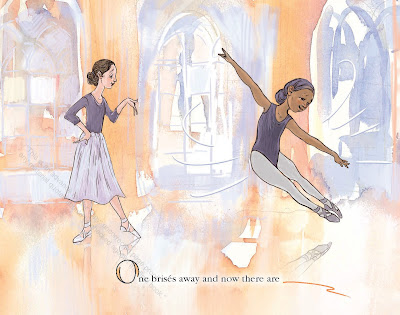
Amanda, Congratulations your upcoming beautiful debut picture book 10
Ballet Dancers . It is
delightful, entertaining, and inclusive. Parents will love it! Kids will love
it! Furthermore, the art by Kathrine
Gutkovskiy is gorgeous! Thank you for agreeing to this interview. I’m
excited to hear about your inspiration and about your fun launch project and
launch party plans. Let’s get started!
1.I hear you're
one of the most sought-after dance teachers in Arizona. Tell me more about your
inspiration to write this book.
I don’t know
about one of the most sought-after dance teachers in Arizona, but I do love
teaching dance and have taught at various places around the valley. I started
teaching dance when I was 17 and have taught children ages 18 months and
up. I teach several adult classes, too. I am also fortunate to have had
the opportunity to teach dance in the entire public school system spectrum, K-12.
I’ve even taught at the Community College level. I love how each age group
brings something different to dance.
As for
inspiration to write this book…being able to combine my passion for dance, both
performing and teaching, with my love of reading and life-long dream to become
a published author was like two puzzle pieces coming together.
I still
remember my first author visit with Mister Tom at my Elementary School. He read
us his book,
Messy Cat. I still own my copy. It was while I sat in awe
of Mister Tom that I dreamed of becoming an author someday.
Fast forward
many decades…eh hem (an era) later and here I am with my debut picture book.
For this
particular book, I have the amazing Tara Lazaar who hosts STORYSTORM every
January to thank for pulling 10
Ballet Dancers out of my head and onto the page. It was only the
third day of the challenge, and I had written down 10-15 ideas when 10 Ballet
Dancers fought for my attention, demanding to be written immediately.
The seed of
the story had been in my brain for so long that when it finally fought its way
to the surface it was fully formed. I made very few changes to the text from
its original draft. Writers refer to this as BIG MAGIC. When I
attended the SCBWI LA Conference in 2019,
Mem Fox was the special guest at the luncheon. She mentioned Ten Little
Fingers and Ten Little Toes only took “15 minutes” to write. I was excited
to learn that I had an experience like Mem Fox.
2. I love that
the art in 10 Ballet Dancers features diversity and inclusivity. Do you find that the
diversity in your book represents the diversity of ballet classes or is this
your dream for the future of ballet?
One of my favorite dance
quotes ever by a famous modern dancer, Jóse Limón is:
“Every man
and woman has the innate ability to dance.”
As humans
dance is part of us. When you
look at babies and how they naturally move to the rhythm of the music it’s hard
to dispute what Jóse Limón said.
I think the
diversity and inclusivity represented in 10 Ballet Dancers is spot on
with the world of dance today. However, not every dance class is going to be
this diverse.
I would say
growing up I was unaware of the dynamics of my classes. I was just there to
dance with the people who were dancing alongside me.
The beauty
of dance is that it is Universal and when the music is on everyone becomes one
with the rhythm.
Today I am
very fortunate to dance in a contemporary company, (Wight Noise Dance Company)
that is both diverse and inclusive the way that 10 Ballet Dancers
depicts the class. The company is slightly different than the book as the members
age range is from 20-50+ years old.
Moment of
TRUTH! My original title for this book was TEN BALLERINAS!
When I began
to think about how I would approach a publisher with my book idea, I planned to
ask the company members to take some pictures of the dance moves so I had a
visual component to help explain the text for those not familiar with Ballet
Terminology.
I caught
myself saying, “What am I thinking! We have two men in our company. I can’t
write a book about dance that doesn’t include boys!” Luckily, it was an easy
switch thanks to both Ballerinas and Ballet Dancers having four syllables!
Speaking of
boy dancers: I remember being on a book thread in 2019 (before I had a publishing
contract) and seeing a parent ask if a particular ballet book featured boys.
The answer was “No.” I screen shot that conversation and thought I’ll get in
contact with the woman who asked the question someday!
I contacted
her the week of August 17. Her son is now going to participate in my project
#flatballetdancers before the book releases. I just popped a postcard in the
mail for him, and will be gifting him and his dance studio a signed copy of 10
Ballet Dancers.
2a. #flatballetdancers!
Tell us about this project.
I am so
excited for this project! #flatballetdancers is inspired by my favorite
children’s book author/illustrator Michelle Nelson-Schmidt. Back in October of
2019 she sent around these cute stuffed dogs named, Rufus and Lucy. We had the
opportunity to house them for a week. It was a fantastic experience. Our boys
really loved it!
To keep
things simple for the project and shipping costs to only one stamp, I chose to
send the characters out like a Flat Stanley. When a person receives the
dancers they have an “adventure” with them and take a picture. They then post
the pic to Instagram using: #flatballetdancers. If they don’t have an Insta
account, they can message me via Facebook, Twitter or my website’s contact form
and then I’ll post them.
 When the
dancers arrive at their home, they contact me, and I provide the next
destination. As the dancers travel through the USA, I will be coloring in
a map for all of their stops. I can’t believe how many travel plans they have
already! 26 states have been secured and 35 trips due to stopping in some
states more than once.
When the
dancers arrive at their home, they contact me, and I provide the next
destination. As the dancers travel through the USA, I will be coloring in
a map for all of their stops. I can’t believe how many travel plans they have
already! 26 states have been secured and 35 trips due to stopping in some
states more than once.
I
would love to see the dancers make it to all 50 States. They will keep
traveling until the book’s One Year Book Birthday! I am all for multiple visits
to states. I will be putting a tally mark in the state for each time the
dancers make a visit. Anyone reading this blog is welcome to contact me to
participate via Facebook (https://www.facebook.com/authormamanda),
Instagram (authormamanda), Twitter (@authormamanda)
or my website (authormamanda.com).
3. Ballet has
some tricky words, so thank you for providing a glossary and pronunciation
guide at the end. What do you say to parents who might stumble over words like
dégagé or glissade when reading with their children?
Parlez-vous
francais? I love to tell my students that they are getting to learn a different
language—French. But instead of telling them I ask them “Do you know what
language you are speaking when you say the Ballet words?
For anyone
who might stumble over the words—just roll with it!
Have fun
enjoying the story, gazing at the AMAZING illustrations by Kathrine
Gutkovskiy, and hopefully the
rhythm of the book will also help naturally guide the way you say the words.
Or…sound out the words with your children. Think of how new readers
break words apart into their letter sounds and syllables. When my children and
I come across a word they don’t know they begin to sound it out. Once they’ve
said all the sounds, I then say, “Now SQUISH it” meaning put all those sounds
together ‘quickly’ to say the word. I think that children will be in awe of
their parents not knowing a word and that the modeling of how to figure out an
unknown word would be an invaluable lesson.
If you’re
still struggling and really want to make sure that you’ve got the pronunciation
correct you can always google it.
3a. I heard
you have a funny story about the rhythm of the book. Tell us!
Well…shhhhhh…it’s
a secret or I at least try to keep it a secret as long as possible.
I may be a
dancer, but I lack internal rhythm. Basically, when the music is on I am
feeling that beat and I am “in the pocket” but as soon as that music turns
off…I am not the one you should ask to lead the movement with counts alone.
So…when
I wrote this book, I wrote it in its current rhythm, but I actually didn’t
recognize the rhythm!
I have an
amazing critique group named Story Stitchers. We meet every two weeks. I was so
excited about 10 BALLET
DANCERS. I could just feel in my gut that this story, of all the stories
I’d written, was the one that was the most polished.
When I read
my manuscript, I read it in an excited yet unrhythmic tone. Almost as if I was
reading a textbook. My critique group would say things like, “That’s a lot of
words we don’t know how to pronounce,” and “Amanda, we know you’ve worked hard
on this, but there just doesn’t seem to be a rhythm to it.”
Completely
distraught that night I turned to my husband Mike, who is fortunately a drummer, and
said, “Honey, does my story have rhythm.” He said, “Yes!”
He’d already
glanced at the manuscript a few times before, but that night as he read he
began to drum out the beat on his leg. We grabbed his bongos and recorded on my
phone. I practiced along with him until I was able to internalize the beat.
I may not be
able to teach the beats to you, however, when I am reading the text now, just
like when the music is on while I’m dancing, something just clicks and
everything works out.
Two weeks
later I was sharing my “new-found” rhythm with my critique group and everyone
agreed that it was ready for submission!
4. What do you
have planned for your debut launch party in the middle of this tough year?
2020 has really thrown everyone into a new way to navigate our
lives.
Lamenting for just a moment. I was really looking forward to having
an in-person event. I think my favorite part would have been seeing the smiling
faces as I signed the books and watching the children handle the book as they
walked away. Would they be hugging it, already flipping through the pages, or
checking out their name written in the book. I had also planned a dance class for people to
learn the moves from the books. My boss, Rachel Wight, at Wight Noise Dance
Company had offered to host the event and planned to invite the Arizona Commission on the Arts.
We are now going VIRTUAL!
https://www.facebook.com/events/2759186857733652/
Tuesday, October 13 at TBD, Join us on 10 Ballet Dancers Book
Birthday, for a read aloud, a drum lesson on the rhythm, a Q&A and
giveaways.
Wednesday, October 14 at 4:30 pm, Join my favorite
author/illustrator, Michelle Nelson-Schmidt as she reads 10 Ballet Dancers during
her weekly Storytime Live. She will be giving away 5 signed copies of the book.
Thursday, October 15 at 3 pm, Join WNDC director Rachel Wight and I
as we chat candidly about dance and how the company helped create photos for 10
Ballet Dancers.
Friday, October 16 TBD, Join my former elementary school librarian
as she reads aloud 10 Ballet Dancers.
The dance class will still be offered. It is now planned for
November; a month after 10 Ballet Dancers launches. A ZOOM link will be emailed
to those who have pre-ordered or order during the launch.
To see the prizes offered and any updates on the schedule check my
website at www.authormamanda.com
5. What were
your favorite books from when you were a child?
As a child,
you would find me in my room most afternoons and weekends curled up with a
book.
My favorite
series was Sweet Valley Twins! I actually still own my copies. I’m so glad I
held onto them, because I will get to share that part of my childhood with our
daughter who was born in February of 2020.
I also loved
reading Beverly Cleary books. I am currently reading through the Ramona series
with our ten-year old son. He is loving them and thinks Ramona’s antics are
hilarious. We’re reading them in order and just started Ramona and Her
Mother. I cannot wait until we get to the toothpaste part. It just might
remind Vincent of his own five-year old brother, Antonio, who used to make
“cakes” out of toothpaste in the sink last year.
I truly
could go on and on about my favorite books. Instead I would like to share what
I believe developed a life-long love of reading for me.
In my
childhood home we had two huge bookshelves at the end of the hallway that
reached from the floor to the ceiling. As a little girl I remember being in awe
of its height and excited to dive into all of the books that packed the
shelves. At a young age I was reading The Red Pony by John Steinbeck
and The Call of the Wild by Jack London. I remember looking at the cover
of White Fang by Jack London many times and opting to not open it
because the cover looked a bit scary. Maybe now I’m old enough to read it!
Having all
of those books at my fingertips led to my passion for the written word and my
exploration to express myself through writing. I feel very fortunate to have
both writing and dance as outlets to navigate life.
In our home
we have books in every room, shelves upon shelves of books. We even have a book
nook under the stairs! Vincent, Roman, Antonio, and Francesca love reading and
being read to. All of our boys also make their own stories often with folded
paper that they staple together. They talk about getting published someday. I
hope that the joy our children find in reading and writing never leaves them.
10 Ballet Dancers available from Small-Tooth Dog Publishing Group: buying link
Indibound: buying link
Amazon: buying link
- ISBN-10 : 1947408259
- ISBN-13 : 978-1947408258
- Product Dimensions : 11.02 x 0.25 x 8.5 inches
- Publisher : Small-Tooth-Dog Publishing Group; Illustrated Edition (October 13, 2020)
- Reading level : 5 - 10 years
- Language: : English
More about Amanda:
Amanda is a native to Arizona, former elementary
school teacher, mother of four, wife to a scientist, dance teacher,
professional contemporary and modern dancer and now a children’s book author.
Her dream of becoming a published author most likely started with experiencing
her first author visit at her elementary school when she was in second or third
grade. The book was Messy Cat written by Mister Tom. Amanda still owns
her autographed copy. Amanda began pursuing her writing career more actively in
January 2017. She joined the Society of Children’s Book Writers and
Illustrators (SCBWI) in July 2017. Since then she has attended three AZ
Conferences and two in LA. In September of 2017, she began taking classes via
StoryTeller Academy created by Arree Chung. Amanda has learned so much from the
classes and is grateful to have found an amazing critique group through the
program. They are called the Story Stitchers. Now, if you asked Amanda when she
started dancing, she’d laugh and say, “the womb,” but then laugh again, and
say, “technically when I was five.” Amanda’s passion for dance and love of
teaching children how to dance has led to the creation of many dance stories.
Some dating back to when she was a new dance teacher at the age of 17. Amanda
is thrilled that The Small Tooth Dog Publishing Group has accepted her debut
dance manuscript about ballet dancers to be published in Fall 2020. She looks
forward to all of the adventures ahead as a debut author and cannot wait to
experience the joy of signing a book for a child at what might be their first
author visit.


.jpg)




 Posts
Posts

