Todd Tuell, author of
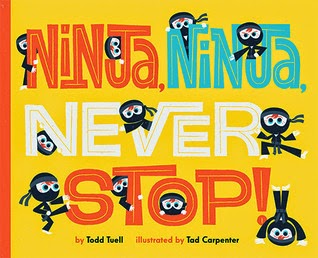
the action-packed picture book NINJA NINJA NEVER STOP
(Abrams, April 2014 ), entertained dozens of kids at his book launch which was
held at that Maime Doud Eisenhower Public Library in Broomfield, Colorado on
April 27, 2014. Kids laughed, danced,
chopped, made crafts, played games, ate ninja-lato, and bought books! It was one of the most successful and exciting
book launch parties I’ve ever seen.
Perhaps Todd has a jump
in the fun-department, since he has previous experience as a preschool teacher.
Whatever his source of ninja moves and magic, kids love his book! Of course
they do—it’s fun, and colorful, and invites the mind to journey on a clever path
full of possibilities. Kirkus reviews says of NINJA
NINJA NEVER STOP, "bright primary hues add energetic yet retro feel to
carpenters illustrations a good choice for mischievous preschoolers with an
interest in martial arts.”
K: Hi, Todd! Thanks for
agreeing to an interview. Congratulations on a fun and fantastic story. Without
a doubt NINJA
NINJA NEVER STOP is a hit! I understand you've already done several school
visits as well as your book launch party. What went into your decision-making
for planning your launch and the school visits?
Thank you so much,
Kim, for this opportunity to share some of what I’ve learned with your readers.
The first thing that
went into planning was to look at my book launch as something bigger than an
individual event. This was great advice I got from my agent, Rubin
Pfeffer. For that, I’ve focused on creating some resources to get kids
excited about the book, about reading and all the fun of being a ninja. By
putting all of this together, I can generate some buzz by helping anyone around
the country host a fun ninja event in places I can’t physically attend. Now
that I’ve put these elements together and tested them out with my own events, I
can distribute them as an online resource kit. You can look for these on my
website in the coming weeks.
It’s also been
important to me to share the experience with those parts of my life that have
been so important. So for my initial events, I approached my children’s
elementary teachers and our local library, practically our second home. These
teachers and librarians have been such a big part of our family and even my
writing career. It was only natural to include them.
K: How do the plans you
make for school visit differ from what you prepare for bookstore or library appearances?
With a school visit
there is inherent structure and elements of decorum. The expected classroom
behavior is understood and generally accepted by the children in the classroom.
In that environment, the kids know how to move from one activity to another.
Additionally, your host in the school, either the teacher or librarian you are
working with, generally has the hope that you’ll bring some type of
academically driven activity to extend what they’ve been doing in the classroom.
The one thing to remember is that you’ll probably only have the teacher with
you in the classroom to help with activities. Make sure that the individual
activities you bring such as writing exercises can be self-directed by the
children.
A library is much
different. It’s a different environment than school, so kids don’t always
understand the rules. Develop a schedule but be ready to adjust. Your audience
can range widely in age, so you’ll need to develop appropriate activities to
engage everyone’s interest. One great thing about a library event is that
parents and other adults will often stay. This makes it easier to break out
into stations so a parent and child can explore a bit more independently. Do
try to have friends and family available to help at each activity. Finally, you
also have to allow for families to come and go as they need.
K: What do you think are
the three most important elements for a successful school visit or book launch,
especially for authors who write picture books?
1. The most important thing is to extend your
book beyond its pages. Engage the kids with activities that enhance the book
experience. Many books are fun for these kids, but you want to make yours stand
out with an outstanding experience.
2. It really helps make the event successful when
you have a champion at the venue, that teacher or librarian who is just as
invested as you in making it a fun and memorable experience for the audience.
3. Learn from each experience for the next.
You’ll see early on how long the kids’ attention span lasts, what’s working for
an age group, and more importantly what’s not. After an event, always ask for
suggestions to make it better. Teachers can pinpoint subtle things that can
make a huge difference because they know these kids so well.
K: At your book launch,
you had various fun station set up for kids --a haiku writing station, Ninja
mask making and painting station, and a cardboard ninja star throwing game
(fun!!) What advice do you have for authors regarding crafts and games?
There were certainly
some lessons learned. I was a little overambitious on the mask making with
paints and markers. I’d suggest always going simple. The kids got too focused
on decorating their masks and didn’t always get to experience the other
activities (plus it makes for a tougher cleanup).
Have lots of help.
Family and writer friends love to celebrate in the launch and jump in to help
lead an activity. This frees you as the author to spend some time individually
with your young fans. Make sure to do that. Ask and answer as many questions.
You should make these kids as important to the event as the book and the
activities.
K: And how did you come
up with the fabulous ideas for your crafts? Furthermore, how many arts and
crafts stations or game stations do you think are important for a book launch?
Does this answer change
for school visits?
I think the number of
activities isn’t as important as making sure what you do have planned is safe,
engaging and somehow relate to your book. That said, a bigger event should have
variety especially if you expect children of varying ages and abilities. You
should have some activities that are self-driven by the kids and others where
they are challenged but guided by a helper or parent. One easy thing is to have
plenty of activity sheets. These are things they can take home, so always brand
them with your book and contact information.
Most of my ideas came
from parenting blogs. You can find craft and activity ideas on most any theme.
Also invite your kids or kids in your target audience to weigh in with ideas.
Don’t forget to ask the host at your event venue, too. They know
specifics about what NOT to include in a program.
The crafts and
activities you choose absolutely depend on the type of launch event. It’s
dependent on the age range, the wider the range, the more offerings you should
have.
Schools are different.
You’ll definitely be limited on the number and type of activities because
you’ll be the primary one leading them. Answering questions and helping 20+
kids can be much tougher. Have samples and prompts prepared if you are doing
some type of writing exercise and do one as a class together so they get the
idea.
K: Todd, I love the song
and lyrics you created, and so did the kids. There was lots of laughter when
they danced to What Would a Ninja Do.
How can other authors go about creating their own music?
Involving music and
movement is ideal for a book event. It’s a fun way to engage the kids because
you are involving so many senses. If you have an idea and want to pursue it,
definitely do it.
It’s great that there
are so many people who love music from high school and college music students
to people who play in the band at a local church. I have no skill when it comes
to music, so I reached out to a guy I’d heard sing many times. I told him what
I was looking for, and was delighted that he was so excited for a fun project.
So don’t be surprised who might lend their talents.
K: Regarding time
management, how much time do you allot to each component of your presentation
to kids?
It’s amazing how the
time for your visits will go by so fast. I think you are wise to keep each
activity to about 7 to 10 minutes. Otherwise, you can start to loose kids.
Alternate your activities between ‘quiet’ ones and active ones. I’d also typically
advise starting with group activities then moving towards the independent ones
to conclude.
I noticed that you
engaged the kids in a question and answer session throughout the presentation.
Smart idea! It kept the kids on their toes and drawn to your presentation. What
other gems of advice do you offer authors to make the visit successful?
Forget that the day is
‘your day’ or a day about your book. Make it all about the kids’ experience.
The book is just a small part of that, but it will be memorable if you’ve made
they time fun.
What process did you go
through with the library to set up your book launch?
For writers, your
librarians should become your best friends. I spend so much time there with my
kids already and was lucky when the time came around for my book to launch, to
have a champion in my home library. Having that support can make an event so
successful and now be able to use her as a reference to get into other
libraries with this program.
It’s a matter of
first, asking if you can provide a program. But be prepared when you make a
contact at your library. Show that you are professional with a full plan for
the event and by explaining how it all ties together as more than a simple
reading if you are asking for support for a launch event.
Finally, be open to
suggestions and change. Most libraries are quite experienced now with wonderful
summer reading programs to have great tie-in ideas. Just listen.
What process have you
gone through to set up your school visits?
You should start now
making friends with your own kids’ teachers and librarians or those in your
neighborhood. As a debut author, I did not have any reference visits to
point to when asking to be a visiting author. So I determined to avoid the red
tape by approaching the administrators of schools. I went straight to classroom
teachers and librarians that I knew. I was prepared with what I could bring and
how that might extend what the kids were doing in class.
I wanted to build up
my experience as a classroom presenter, so initially I have not asked for a
visit fee. That’s a great way to get a foot in the door. Most teachers will
jump at a chance to bring in an author to speak to kids. If you’re charging
little or nothing to speak, they’ll be happy to generate some buzz with parents
and send pre-order forms home with kids in advance of your visit. The kids take
home a flyer so they are anticipating something cool is coming up. They are
ready and looking forward to the event. Create the order form and email it to
your teachers. Make it easy for them to sell your book and kids’ parents to buy
it.
What’s the best parting advice
you can give us about creating a successful book launch event?
It’s all about
preparation. With the agent advice I mentioned earlier, I say spend time on
creating and testing out activity ideas that enhance your story and make the
entire event memorable. These are things you’ll be able to use again and again
once you’ve got them in your pocket.
The best thing I did
was to get into a smaller environment first to learn some lessons. I suggest
you incorporate as many senses as possible, especially movement. There is so
much research indicating how cross-body movements create cross-brain activity
and connectivity in children.
Thank you so much for
your time, Todd!
Todd Tuell is the
co-regional adviser to the Rocky Mountain chapter of the Society of Children's Book
Writers and Illustrators (SCBWI). NINJA NINJA NEVER STOP is his debut book.
If you are in the Denver
area and would like to bring your child to Todd’s next event, please join him
at Tattered Cover Book Store in Highlands
Ranch at 10:30am.
Location: 9315
Dorchester Street in the new Highlands Ranch Town Center on Highlands Ranch
Parkway between Broadway and Lucent Boulevards. A parking lot is conveniently
located in the front of the store. The zipcode is 80129.
Or you can find him at Barnes and Noble
in Boulder in June, 2999 Pearl Street, Boulder CO 80301
Don’t miss Todd at the 95th
ANNIVERSARY CHILDREN’S BOOK WEEK CELEBRATIONS!!
MG/YA Author Panel
Wednesday, May 14th, 6:30p.m.
Tattered Cover Colfax, Denver
Join Melanie Crowder, Lindsay Eland, Claudia Mills, Ellen Mahoney,
Christine Liu-Perkins and Barbara Wright as they
present their recently published novels and participate in a panel Q&A.
There will be door prizes and a drawing for a Young Author manuscript critique!
Picture Book Group Story Time
Saturday, May 17th, 10:30a.m.
Tattered Cover Highlands Ranch
Celebrate the beauty and wonder of picture books written by Libby
Martinez, Jean Reidy, Todd
Tuell and Nicole Weaver. There will be readings by
each author as well as door prizes and fun activities for all attendees!
ABOUT CHILDREN'S BOOK WEEK
Children's Book Week is the annual celebration of books for young people and
the joy of reading.
Established in 1919,
Children's Book Week is the longest-running national literacy initiative in the
country. Every year, commemorative events are held nationwide at schools,
libraries, bookstores, homes -- wherever young readers and books connect!
Children's Book Week is
administered by Every Child A Reader, a 501(c)(3) literacy organization
dedicated to instilling a lifelong love of reading in children. The Children's
Book Council, the national non-profit trade association for
children's book publishers, is an anchor sponsor.
Show message history


.JPG) 2.
Use consonants to nail humor. Comedy writers say consonants are
funnier than vowels, so revise word choice where needed. For example, corndog is funnier
than ice cream, upchuck is funnier than vomit.
2.
Use consonants to nail humor. Comedy writers say consonants are
funnier than vowels, so revise word choice where needed. For example, corndog is funnier
than ice cream, upchuck is funnier than vomit.



.JPG) 10. 10. Add tools (craft books) to your toolbox:
10. 10. Add tools (craft books) to your toolbox: 




 Posts
Posts

